
Every drowsy morning, countless people rely on coffee to pull their brains out of “standby mode” and back to reality. Some are captivated by the nutty and caramel aromas of roasted beans, while others view coffee as a “social lubricant.”
It is estimated that over 10 billion kilograms of coffee are consumed globally each year. It has seeped into work rhythms and urban life, and also entered the realm of health research. Growing evidence suggests that coffee not only boosts alertness but may also be associated with a lower risk of neurodegenerative diseases and even longer life.
Recently, a study published in the BMJ sub-journal BMJ Mental Health by researchers from institutions such as King’s College London added robust evidence to the micro-level health benefits of this “life-extending elixir.”
The study indicates that daily consumption of moderate amounts of coffee (particularly 3–4 cups) is significantly associated with longer telomere length. This association translates to a biological age approximately 5 years younger.

DOI: 10.1136/bmjment-2025-301700
Before delving deeper, it’s essential to clarify the concept of “telomeres.”
To visualize it, the chromosomes in human cells are like delicate shoelaces. Telomeres, then, are the small plastic tips at both ends of these shoelaces. They protect the main body of the shoelace (the DNA carrying genetic information) from wearing out, fraying, or tangling with others during repeated cell divisions and replications.
With each cell division, telomeres irreversibly erode and shorten. When they become too short to provide protection, the cell ages or dies. Therefore, telomere length is widely recognized as a core biomarker of cellular aging.
This study recruited 436 volunteers diagnosed with severe mental disorders. Among them, 259 belonged to the schizophrenia spectrum, and 177 had mood disorders (including bipolar disorder and depression with psychotic symptoms).
Based on their daily coffee consumption, the researchers divided the volunteers into four groups: the no-coffee group (0 cups/day), the light-drinking group (1–2 cups/day), the moderate-drinking group (3–4 cups/day), and the heavy-drinking group (5 or more cups/day). White blood cells were extracted from each volunteer’s blood, and telomere length was measured using real-time quantitative PCR technology.
The analysis results showed that, compared to the no-coffee group (0 cups/day), those drinking 3–4 cups of coffee daily had longer telomeres.
According to previous research, telomeres shorten by approximately 70 base pairs on average each year. The researchers calculated the difference in telomere length between coffee drinkers and non-drinkers, adjusted for various confounding factors, and found that the telomere length advantage from drinking 3–4 cups of coffee daily is roughly equivalent to a biological age 5 years younger.
Compared to those who do not drink coffee at all, even “light drinking” of 1–2 cups of coffee daily also showed an increase in telomere length.
However, excessive coffee consumption—5 or more cups per day—resulted in a significant decline in telomere length.
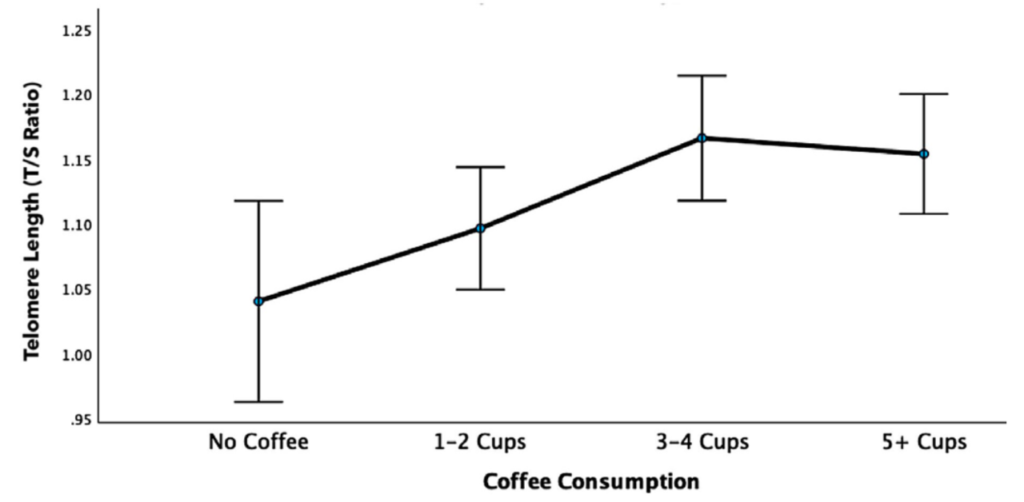
The Association Between Coffee Intake and Telomere Length
So, how exactly does coffee affect telomere length?
The researchers also proposed several possible explanations. Coffee is rich in various bioactive compounds such as chlorogenic acid and cafestol, which can activate the Nrf2 pathway—a core antioxidant defense mechanism. Simultaneously, these components in coffee can help suppress chronic inflammation. Chronic inflammation is both a common pathological feature of severe mental disorders and a factor that damages telomeres. Therefore, coffee may provide a protective shield for the already vulnerable telomeres of this group through its dual effects of “antioxidant” and “anti-inflammatory.”
From another perspective, maintaining telomere length relies on the key “repair tool”—telomerase. Caffeine may indirectly upregulate the activity of this enzyme by influencing the Akt/GSK3β/β-catenin signaling pathway within cells.
Moreover, caffeine can enhance the promoter activity of the telomerase gene, leading cells to produce more telomerase, thereby effectively lengthening telomeres.
Of course, excessive coffee consumption still carries risks. Once caffeine intake surpasses a certain threshold, it may shift from being a “protector” to a “destroyer,” promoting the generation of harmful reactive oxygen species, exacerbating oxidative stress, and accelerating telomere erosion.
Overall, for populations facing higher health risks (such as the mental disorder patients focused on in this study), keeping daily caffeine intake within an appropriate range (equivalent to 3–4 cups) might be a feasible and cell-healthy habit.
That said, this study by no means encourages everyone to start indiscriminately gulping down coffee. Sensitivity to caffeine varies from person to person. For individuals with hypertension, adolescents, pregnant women, and those with slow caffeine metabolism, recommendations should remain conservative and tailored to the individual.
Of course, this study also has its limitations. It is primarily based on a cross-sectional design, making it impossible to determine whether “drinking coffee leads to longer telomeres” or whether those with “innately longer telomeres and more resilient bodies” are more inclined to enjoy coffee.
Telomeres are just one of many biomarkers used to measure aging. To comprehensively assess coffee’s “age-defying effects,” future research will need to incorporate other dimensions such as epigenetic clocks and brain age for comprehensive validation.