
The final days of February 2026 brought a mix of innovation, expansion, and reputational challenges for the tea and coffee industry. From a major experimental store launch in Shanghai to legal action against false information and continued international growth, today’s news reveals a sector navigating complex market dynamics both at home and abroad.
1. January Data Shows Slowing Domestic Market
New data reveals a complex picture for China’s tea and coffee market entering 2026. In January, the top 15 tea and coffee brands by store count launched a total of 94 new products, comprising 60 new teas and 34 new coffees. However, this wave of product innovation was contrasted by shifting store counts. Across 29 major tea brands, the total number of outlets decreased by a net 668 stores in January, with 3,125 openings offset by 3,793 closures.
This data suggests a market that is becoming saturated and increasingly competitive. While brands continue to fight for consumer attention through frequent new product releases, the net reduction in store count points to a period of consolidation and optimization, where unprofitable locations are being pruned in favor of more sustainable growth.
2. Heytea (喜茶) Debuts Lab 2.0 in Shanghai
Heytea(喜茶) opened the doors to its first “Lab 2.0” store in Shanghai today, marking a significant evolution in its experimental store format. Located in the Jing’an district, the new location is the brand’s first to integrate four distinct laboratories—tea lab, cake lab, gelato lab, and bake lab—into a single space .
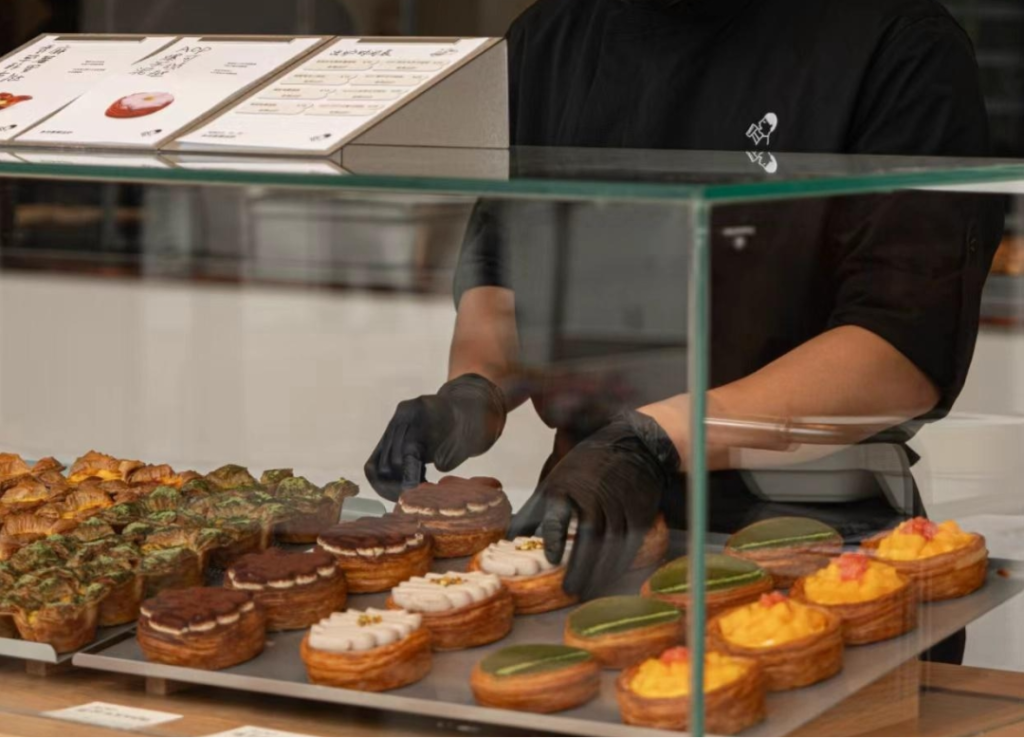
The Shanghai Lab 2.0 store features over 70 beverage options, including three exclusive tea-based specialties. Among these are a limited-edition drink made with local Chongming rice brew, highlighting a focus on regional ingredients and product experimentation . This launch continues Heytea(喜茶) ‘s strategy of using flagship stores to test innovative concepts and create unique consumer experiences beyond its standard offerings.
3. ChaPanda (茶百道) and TANING (挞柠) Expand Global Footprint
Chinese tea brands continue to aggressively pursue international growth, with ChaPanda(茶百道) and TANING(挞柠) announcing new store openings. ChaPanda(茶百道) is set to open three new locations in South Korea—its first in Busan, as well as in Noryangjin and Seongsu—following the recent launch of a ChaPanda(茶百道) store in Seoul’s Coex mall on February 24. This builds on the brand’s established presence in the country, where it has been adapting its menu to local tastes . Meanwhile, TANING(挞柠) opened its fourth location in New Zealand on February 27, at the Botany Town Centre in Auckland.
The continued push into markets like South Korea and New Zealand demonstrates the long-term commitment of major Chinese brands to capturing market share overseas. For TANING(挞柠), which reports over 1,000 stores globally, this latest opening reinforces its strategy of steady international expansion .
4. Luckin Coffee (瑞幸咖啡) Opens Hong Kong, Macau Franchising
Luckin Coffee(瑞幸咖啡) announced it is officially accepting franchise applications for the Hong Kong and Macau Special Administrative Regions, effective immediately. This move signals the brand’s next major step in expanding its reach within China’s greater bay area. The announcement comes as Luckin Coffee(瑞幸咖啡) continues to recover and grow its massive domestic footprint, which surpassed 10,000 stores as of November 2025. Entering these new, competitive markets will test the brand’s ability to adapt its value-driven model to different consumer landscapes.

Summary
Today’s updates paint a portrait of an industry in flux. Domestic leaders like Heytea(喜茶) are pushing the boundaries of the physical store experience while others like ChaPanda(茶百道) and TANING(挞柠) look to international markets for growth. Simultaneously, established players face the challenges of a consolidating domestic market and the need for meticulous brand management, both online and offline.
